Solar lighting for universities is off-grid outdoor lighting where each pole carries its own solar panel, battery, and LED fixture. Because nothing connects to the campus grid, schools can light parking lots, walkways, and remote corners without trenching, new wiring, or monthly power bills, and the lights keep running during outages.
That matters because the darkest spots on a campus rarely sit next to an electrical panel. Think of the overflow lot at the edge of the property, or the shortcut behind the residence halls. Students avoid these places after dark, and they’re often the costliest to wire.
Running grid power out to them means cutting through asphalt and lawns, pulling permits, and waiting on utility work. A simple lighting fix can stretch across a whole semester. Solar fixtures skip most of that.
This guide covers where solar works on a campus, how it compares with grid-tied lights, which standards apply, and how to plan a project that facilities and security can both sign off on.
What Solar Lighting for Universities Includes
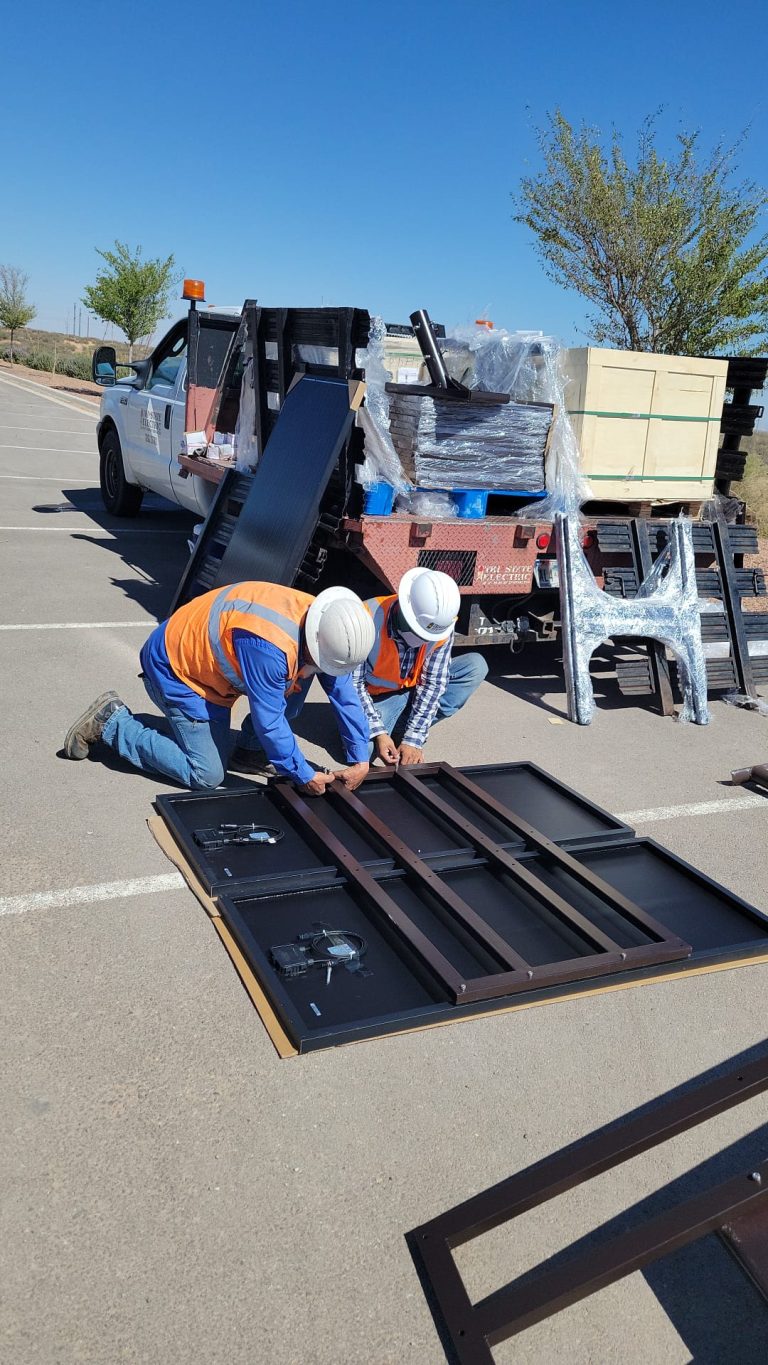
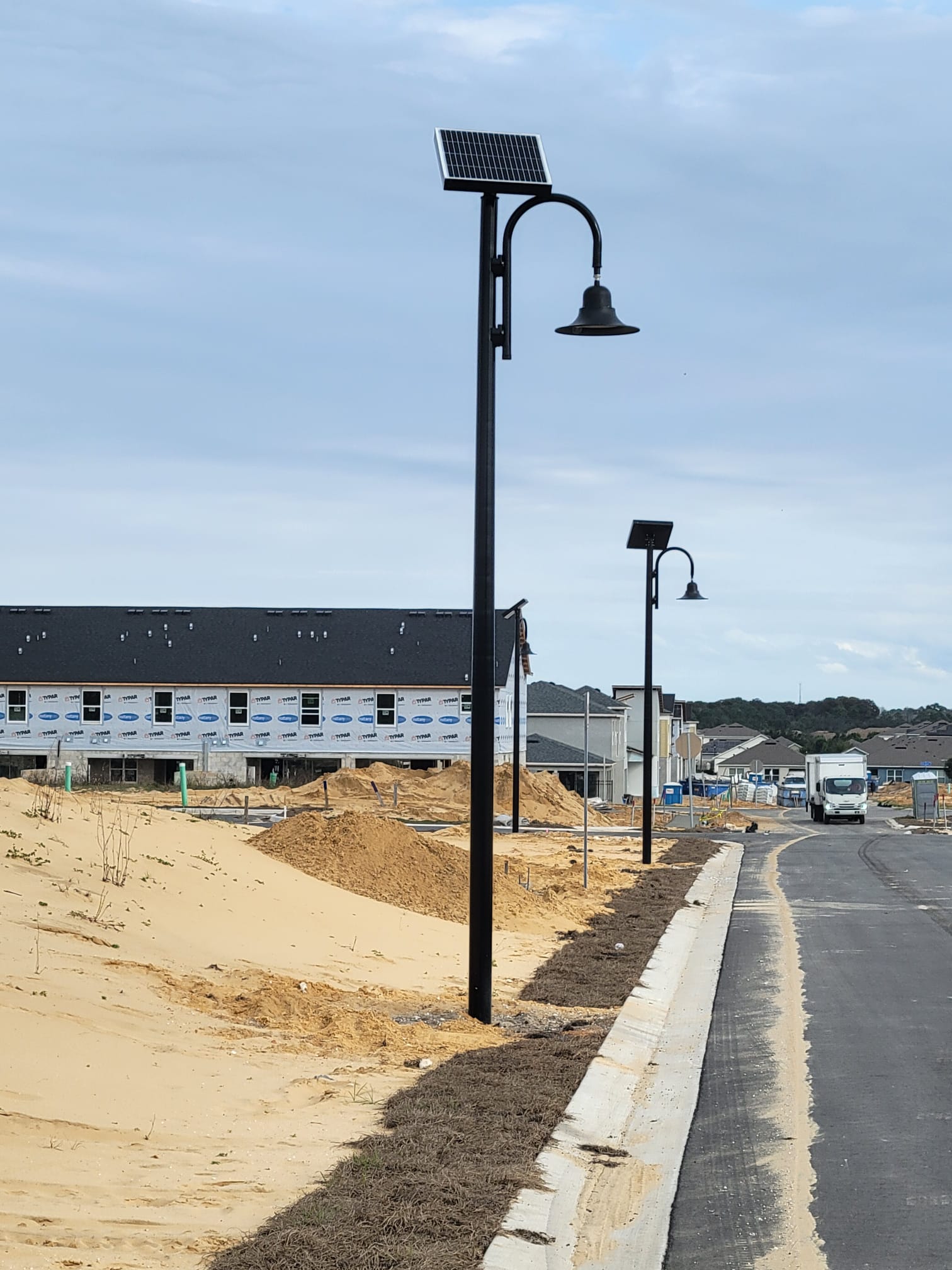
A campus solar light is a self-contained system. A photovoltaic (PV) panel charges a battery during the day, an MPPT charge controller manages that charging, and an LED fixture runs from the stored power at night. Each pole works on its own, so one faulty unit never darkens the rest of the row.
Two designs show up on most campuses. All-in-one fixtures pack the panel, battery, and light head into a single unit, which keeps them compact and quick to mount on 15- to 25-foot poles. All-in-two systems separate the panel from the light head, leaving room for a bigger panel and battery on taller poles.
Battery chemistry matters more than most buyers expect. Infrastructure-grade fixtures, including ours, run on lithium iron phosphate (LiFePO4) batteries. You can compare the options in our breakdown of solar light battery types.
Why Dark Spots on Campus Are So Hard to Fix With Grid Power
Most lighting gaps on a campus come down to one problem: distance from existing power.
Parking Lots & the Walk to the Car
Parking lots are where campus lighting complaints usually start, because they sit at the edge of the property and far from building power. Lighting them with grid-tied poles means trenching through asphalt, running conduit, and patching pavement afterward. That’s why so many outer lots stay dim for years.
One published case from an 80-acre community college shows the pattern. Students said they felt unsafe in the parking lots and on the walk to class, and wiring new grid-tied poles past existing buildings and landscaping would have been too costly. The college chose solar instead.
It avoided roughly 20 percent of the system cost at installation by skipping the trenching and wiring. It also reported saving more than $8,000 a year on electricity.
Light distribution matters as much as brightness. Type III and Type IV patterns throw light wide across stalls and drive aisles, while Type II suits narrow paths. Spacing poles by eye leaves dark pockets between rows. Our guide on sizing a solar street light system for a parking lot covers spacing in detail.
Pathways, Quads, & Late-Night Routes
Walkways need light because students cross campus at all hours, from late labs to closing shifts at the library. A route that goes dark for even one stretch changes how people move. They take longer detours, or they walk through spots they’d rather avoid.
Solar bollards and pathway lights do most of the work here, sitting low and lighting the ground without glare. Taller all-in-one poles cover shuttle stops and plaza edges.
Solar also solves two problems grid lighting creates. There’s no underground copper to steal, which matters on campuses where wire theft has knocked out pole lights before. And when a storm cuts building power, the walkways stay lit, because each pole runs on its own battery.
Solar vs Grid-Tied Campus Lighting: Cost & Timeline
Solar lighting for universities usually wins on installed cost wherever new lights would need new wiring. On a typical 20-fixture pedestrian project, grid-tied lighting can carry $80,000 to $150,000 in trenching and electrical work alone and take 6 to 12 weeks. A solar equivalent installs in 5 to 10 crew days.
| Factor | Grid-tied lighting | Solar lighting |
|---|---|---|
| Trenching and conduit | Required for every pole | None |
| Utility coordination | Service drop and scheduling needed | None |
| Install time (20 fixtures) | 6 to 12 weeks | 5 to 10 crew days |
| Total installed cost | Baseline | About 40 to 60 percent of grid-tied |
| Monthly energy bill | Yes, for the life of the system | None |
| During a power outage | Lights go dark | Lights stay on |
| Copper theft risk | Underground wire is a target | No buried wire |
| Impact on grounds | Torn-up lawns, lots, and walkways | Pole bases only |
Cost figures as of October 2026.
Grid power still makes sense in some spots. If a lot already has working poles and conduit, an LED head retrofit may cost less than going solar. The math flips when the site has no power nearby, or when digging would damage mature trees or fresh paving.
You avoid the trenching bill at installation, then skip the electricity bill every month after. Our article on solar lighting ROI and payback shows how to run those numbers for your own site.
Where Solar Fits on a Campus
Solar works best in spaces far from building power and in spaces where digging would damage something worth keeping. On most campuses, that means perimeter parking, connecting paths, transit stops, athletic fields, and entrance signs.
| Campus area | Fixture type | Typical setup | Why solar works here |
|---|---|---|---|
| Perimeter parking lots | All-in-two pole lights | 25 to 30 ft poles, 6,000 to 12,000 lumens | Far from building power, wide areas to cover |
| Walkways and quads | Bollards and pathway lights | Pedestrian-scale mounting | No digging through lawns or hardscape |
| Shuttle and bus stops | All-in-one or canopy lights | 15 to 25 ft poles, 3,000 to 6,000 lumens | Small footprint, quick install |
| Athletic and practice fields | High-output all-in-two or flood lights | 30 to 50 ft poles, up to 50,000 lumens per head | Avoids transformers and long trench runs |
| Entrances and signage | Monument lights | Low-profile mounting | Lights the campus name without new circuits |
At SolarPath Sun Solutions, we design solar lighting for schools and universities in all 50 states. Each project gets the fixture its site needs, not one catalog model stretched to fit everything.
Athletic fields need their own planning pass. Field lighting runs on practice and game schedules, so panels and batteries are sized for that duty cycle, not all-night operation. Our sports field solar lighting page explains how those schedules work.
How Campus Solar Lights Stay On All Night
Two things keep a solar light running until sunrise: correct sizing and smart controls.
Sizing for Your Sun & Your Winters
A solar light stays on all night because the system is sized for the worst days of the year, not the best ones. Designers look at peak sun hours, solar irradiance, the lumen output you need, and how many cloudy days in a row the battery must cover. Then they match the panel and battery to those numbers.
That’s why we size solar lighting for a campus in Arizona very differently from one in Maine. Short December days and snow on the panels push northern projects toward bigger batteries and steeper panel angles. Desert sites face the opposite problem: summer heat on the battery and electronics.
Our fixtures carry an IP66 rating and run from -40°F to 158°F, so they handle a frozen January and a scorching August.
The most common mistake is buying fixtures sized for summer sun. By January, they’re dimming out at 3 a.m., right when a student walks back from a late study session.
Ask any supplier one question: how many nights of autonomy is this system designed for, and in which month?
Smart Controls, Dimming, & Motion Sensing
Controls stretch every watt-hour the battery stores, and they’re where solar lighting for universities gets tuned to campus life. A typical campus profile runs lights at full output through the evening rush, dims them during the quiet hours after midnight, and brightens them when a motion sensor picks up someone on the path.
This saves battery capacity for long winter nights and gives a visual cue when someone is moving nearby.
Controls can also follow your calendar. Athletic lighting can switch on for scheduled practices and shut off afterward. Event lots can run brighter on game days.
One practical tip: decide your dimming schedule with campus security before installation, not after. Security teams may want certain routes at full brightness all night, and that choice changes battery sizing. It’s far cheaper to plan for it on paper than to swap batteries later.
Lighting Standards & Dark-Sky Rules to Check
Solar lighting for universities should meet the same photometric standards as municipal lighting. For walkways, plazas, and parking, that usually means IES RP-8 targets. For athletic fields, it means IES RP-6.
Here’s what to check on a spec sheet or photometric report:
- Uniformity ratio: below 4:1 for pedestrian areas, so there are no bright pools next to dark gaps.
- Light levels: minimum maintained footcandles between 1 and 3 across pedestrian sites.
- Color temperature: 3000K or 4000K CCT, which suits dark-sky ordinances.
- Optics: full-cutoff fixtures that send light down, not into the sky or into residence hall windows.
- Listings: UL listing for safety, plus Dark Sky approval if your campus or county requires it.
- Weather rating: IP66 or better for dust and driving rain.
Light trespass is a real campus issue for residence halls and observatories. Full-cutoff optics and careful aiming fix most of it.
The best proof is a stamped photometric study. It shows lux levels, uniformity, and pole placement before procurement, so nobody discovers a dark corner after the poles go in.
How to Plan a Campus Solar Lighting Project
Start with a walk at night, not a product catalog. Strong projects for solar lighting for universities begin by mapping where people actually go after dark, then matching fixtures, pole heights, and battery sizing to each zone.
- Do a night audit. Walk the campus after dark with security, facilities staff, and a few students. Mark dark spots, broken lights, and routes people use but nobody planned for.
- Rank the zones. Put the highest-traffic dark areas first, usually perimeter lots, shuttle stops, and the paths between housing and academic buildings.
- Collect site details. Note pole locations, mounting heights, and anything that shades the panels, like buildings or tree canopies.
- Get a photometric study. Confirm lux targets and uniformity before any purchase order goes out.
- Line up funding and approvals. Match the project to the right budget cycle, grant timeline, or capital plan.
- Install and set schedules. Commission each pole, then program dimming and run times with security’s input.
SolarPath Sun Solutions includes a stamped photometric study with every project, so your team sees fixture placement and light levels before anything is ordered.
Watch the trees, too. A sapling beside a pole today can shade its panel within a few years.
Funding, Procurement, & Long-Term Upkeep
Getting solar lights approved and keeping them running are both simpler than most facilities teams expect.
Paying for Campus Solar Lighting
Most campus lighting projects draw on capital budgets, deferred maintenance funds, or grants. Solar’s short install window helps, since projects can wrap up inside a fiscal year or before a grant deadline instead of waiting months on utility coordination.
Grant eligibility depends on who owns the project. Some safety grants, such as Safe Streets and Roads for All (SS4A), go to public agencies rather than universities directly. A campus can still benefit when a city lights a crosswalk or transit stop next to its property. We don’t provide grant funding and can’t guarantee eligibility, but our fixtures are often part of projects pursuing this kind of funding.
If federal money is involved, ask early whether fixtures meet Build America, Buy America requirements. Our page on BABA-compliant solar lighting covers that topic.
What Maintenance Looks Like
Solar lights cut the two biggest maintenance headaches of grid lighting: buried wiring faults and monthly energy bills. There’s no cable to locate, dig up, and repair when a circuit fails. Each pole stands alone, so a problem stays with one fixture.
Panels still collect dust, pollen, and bird droppings, so a quick cleaning during routine grounds work keeps them charging well.
In snowy climates, check panels after heavy storms and clear them if snow doesn’t slide off on its own. Trim trees before they start shading panels. Batteries eventually need replacement, so plan for it in your long-term budget.
One simple habit helps: tag every pole with an ID number and keep a log of cleanings, checks, and any issues. Every fixture we supply also comes with a product-specific warranty.
Frequently Asked Questions
Are solar lights bright enough for university parking lots?
Yes, when they’re sized correctly. All-in-two solar fixtures on 25 to 30 foot poles deliver 6,000 to 12,000 lumens with Type III distribution, which suits parking lots and wide drive aisles. A photometric study confirms the design meets IES RP-8 targets before you buy, so brightness is proven on paper first.
Do solar campus lights work in winter or cloudy weather?
They do if the system is sized for winter. Designers plan around the shortest days and longest stretches of cloud, choosing larger batteries and panels for northern campuses. Fixtures sized only for summer sun often dim early in winter, so always ask which month the system was designed around.
How long does it take to install solar lighting on a campus?
Much faster than grid-tied lighting. A 20-fixture solar project typically installs in 5 to 10 crew days, compared with 6 to 12 weeks for grid-tied work that needs trenching and utility coordination. Short timelines let campuses finish during breaks, before students return.
Can solar lights work alongside existing grid-powered lights?
Yes. Many campuses keep grid lighting where the wiring already works and add solar where it doesn’t, such as new parking areas, remote paths, or spots where old circuits keep failing. The two systems run independently, so adding solar doesn’t require any changes to your existing electrical setup.
Do solar lights meet dark-sky requirements?
They can. Look for 3000K or 4000K color temperature, full-cutoff optics that aim light downward, and a Dark Sky listing where your campus or county requires it. These features also cut light spilling into residence hall windows and keep the night sky visible for campus observatories.
What does solar lighting for universities cost to run each year?
There’s no electricity bill, since each pole generates its own power. Running costs mostly come down to occasional panel cleaning, tree trimming, routine checks, and eventual battery replacement. Compared with grid-tied poles, you also avoid repair costs for buried wiring faults and copper theft.
Light Your Darkest Campus Routes Without Digging
The fastest way to start is with your worst dark spot. Pick the parking lot, path, or shuttle stop that draws the most complaints, and we’ll show you what solar would look like there, from fixture choice to a stamped photometric layout.
SolarPath Sun Solutions engineers solar lighting for colleges and universities in all 50 states, with local representatives who know regional sun conditions and procurement rules. Our engineering and project teams respond within one business day, whether you’re planning a 10-fixture pilot or a campus-wide rollout.
Call us at 201-490-4499 or email [email protected] to talk through your site. Or request a campus quote and share your project size, timeline, and funding source so we can scope it right the first time.
Prices are estimates. Contact us for a current quote.