
North Carolina averages 4.5 to 5.0 peak sun hours (PSH) per day, with the coastal plain and Piedmont regions reaching the higher end. Annual solar irradiance averages 1,500 to 1,650 kWh per square meter. SolarPath Sun Solutions deploys solar lighting across North Carolina interstate corridors, Research Triangle campus environments, rural electric cooperative territories, and coastal parks where wind resilience and dark-sky compliance shape specifications.
Every fixture ships UL and Dark Sky listed, pairs a lithium iron phosphate (LiFePO4) battery with an MPPT charge controller, and carries an IP65 or IP66 ingress protection rating. North Carolina’s Renewable Energy and Energy Efficiency Portfolio Standard (REPS) and state-level incentive programs support solar deployments. NREL data ranks North Carolina among the top five US states for cumulative solar installed capacity.
SolarPath solar lighting across North Carolina. We serve Charlotte and Mecklenburg County, the Research Triangle of Raleigh, Durham, and Chapel Hill, the Greensboro and Winston-Salem Triad, and Asheville. Corridors along I-40 and I-85 use NCDOT-aligned fixtures with rural-cooperative support and LiFePO4 batteries sized for 4.5 to 5.0 peak sun hours.
SolarPath Sun Solutions deploys solar lighting across Solar Lighting Solutions in North Carolina with a single-source platform for products, photometric design, and installation. Every project runs on UL and Dark Sky listed hardware, pairs a lithium iron phosphate (LiFePO4) battery with an MPPT charge controller, and delivers three to seven days of autonomy based on the site’s peak sun hours (PSH). Browse our product families and application categories below to match the right fixture to your Solar Lighting Solutions in North Carolina project.
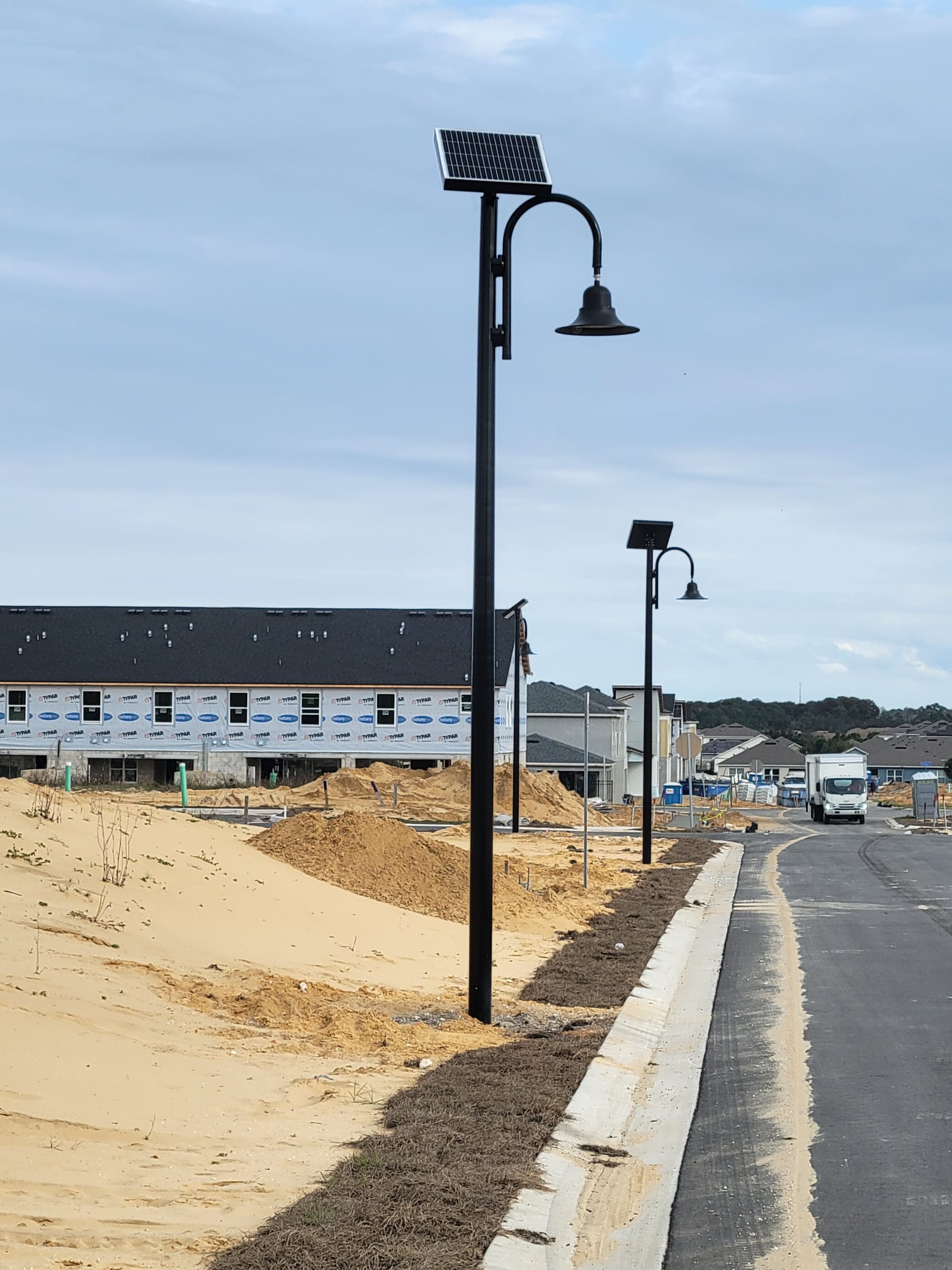
Solar Street and Area Lights form the core of most SolarPath deployments in Solar Lighting Solutions in North Carolina. Our all-in-one and all-in-two fixtures deliver 3000 to 12000 lumens with Type II and Type III photometric distribution, 3000K or 4000K CCT, and four-day autonomy on a single charge. Every fixture ships with an IP65 or IP66 ingress protection rating and a product-specific warranty covering the photovoltaic panel, LiFePO4 battery, MPPT controller, and LED array.
Parking Lot and Roadway Lighting targets 1 to 3 footcandles average maintained at uniformity ratios below 4:1. Solar Lighting Solutions in North Carolina projects typically use all-in-two fixtures at 20 to 30 foot pole heights, eliminating trenching, conduit, and utility hookup. Roadway applications meet IES RP-8 standards with Type II and Type III distribution tuned to the corridor geometry.
Park, Pathway, and Bollard Lighting combines dark-sky compliance with pedestrian-scale illumination. SolarPath bollards and decorative LEDs deliver 400 to 1200 lumens with full-cutoff optics, 3000K warm CCT, and CRI 80+ for color-accurate wayfinding on Solar Lighting Solutions in North Carolina civic and campus sites. Every fixture meets International Dark-Sky Association (IDA) ordinances.
Security and Perimeter Lighting protects Solar Lighting Solutions in North Carolina storage yards, industrial sites, and municipal facilities with motion-triggered flood lights and wall packs. PIR sensors, two-stage dimming, and 4000 to 8000 lumen bursts extend autonomy during low-activity hours while delivering instant full output when movement is detected.
Sports Field and Recreation Lighting handles Solar Lighting Solutions in North Carolina athletic facilities, school playfields, and community recreation sites. High-output all-in-two fixtures deliver 10000 to 20000 lumens per head, pair with pole heights of 30 to 50 feet, and run on scheduled timers that match league and practice hours.
Specialty and Decorative Lighting covers Solar Lighting Solutions in North Carolina monument lighting, canopy fixtures, traffic signals, solar charging poles, and custom-CCT decorative LEDs. Every specialty product runs on the same LiFePO4 and MPPT platform as our standard catalog, so project managers retain one warranty, one point of contact, and one accountable partner across mixed-fixture specifications.
SolarPath Sun Solutions ships and supports solar lighting projects across the United States. Our engineering and logistics teams handle every deployment from coastal Florida to the Colorado Rockies, with region-specific peak sun hours modeling and compliance support baked into every quote.
SolarPath solar lighting deployments across California — from Los Angeles parking facilities to Bay Area municipal projects. Our California team coordinates UL and Dark Sky listed equipment with CEC-compliant installations.
Texas solar lighting projects spanning Houston, Dallas, Austin, and San Antonio. High peak sun hours make Texas ideal for off-grid parking lot, roadway, and industrial site deployments.
Florida solar lighting installations engineered for Category-5 wind loads and salt-air environments. Miami-Dade NOA certified mounting for hurricane-zone parking, pathway, and municipal lighting projects.
New York solar lighting serving NYC boroughs, Long Island, and upstate municipalities. LiFePO4 battery systems sized for northern-latitude winter autonomy and DEC dark-sky compliance.
North Carolina averages 4.5 to 5.0 PSH depending on region. The coastal plain and southern Piedmont reach 4.8 to 5.0, and the western mountains trend toward 4.5 due to higher elevation and cooler temperatures.
Poles and brackets are rated for 150 mph wind loads standard, with 180 mph hardening available for Outer Banks and Category II risk zones. Fasteners are marine-grade 316 stainless, and battery compartments are sealed against salt-air intrusion.
REPS primarily credits grid-tied generation, but UL and Dark Sky listed SolarPath fixtures align with the state's municipal resilience targets and may qualify under utility-level lighting rebate programs.
Yes. Our fixture platforms meet North Carolina Department of Transportation Standard Specifications Section 1098 for highway lighting. Stamped photometric studies and pole specifications are available on request.
Yes. Rural cooperative territories cover roughly half the state by land area, and off-grid fixtures avoid the trenching and interconnection overhead that cooperative service often cannot absorb. County fairgrounds, community centers, and fire station access roads are common deployment types.
North Carolina sites typically ship with four-day autonomy to cover summer thunderstorm cycles and winter shorter daylight hours. Coastal sites may specify five-day autonomy during hurricane season.
North Carolina offers a property tax exemption for solar energy equipment under N.C.G.S. Section 105-275(45) and various local utility rebate programs. Documentation is provided on procurement.
Request a free solar lighting audit and discover how off-grid lighting can reduce your operating costs to zero.
Or call 201-490-4499