
Lighting on tribal land often means lighting where the grid does not reach. Extending utility service to reservation roads, community centers, and housing areas costs $80,000 to $150,000 in trenching and electrical work for a typical 20-fixture project — before a single fixture mounts — and adds decades of monthly energy billing on infrastructure the utility may be slow to maintain.
SolarPath Sun Solutions removes the grid from the equation entirely. Each fixture runs on a lithium iron phosphate (LiFePO4) battery, MPPT charge controller, and photovoltaic panel mounted on the pole — no grid extension, no trenching, no utility coordination, and no recurring energy cost. A 20-fixture project installs in 5 to 10 crew days at 40 to 60 percent of the installed cost of a grid-tied equivalent, and meets IES RP-8 illumination standards with uniformity ratios below 4:1 and 1 to 3 footcandles average maintained.
Projects of this type are regularly funded through the Tribal Transportation Program (TTP), the BIA Road Maintenance Program, Indian Community Development Block Grants (ICDBG), and tribal housing authority capital budgets. Browse our all-in-two street lights, all-in-one fixtures, and solar bollards.
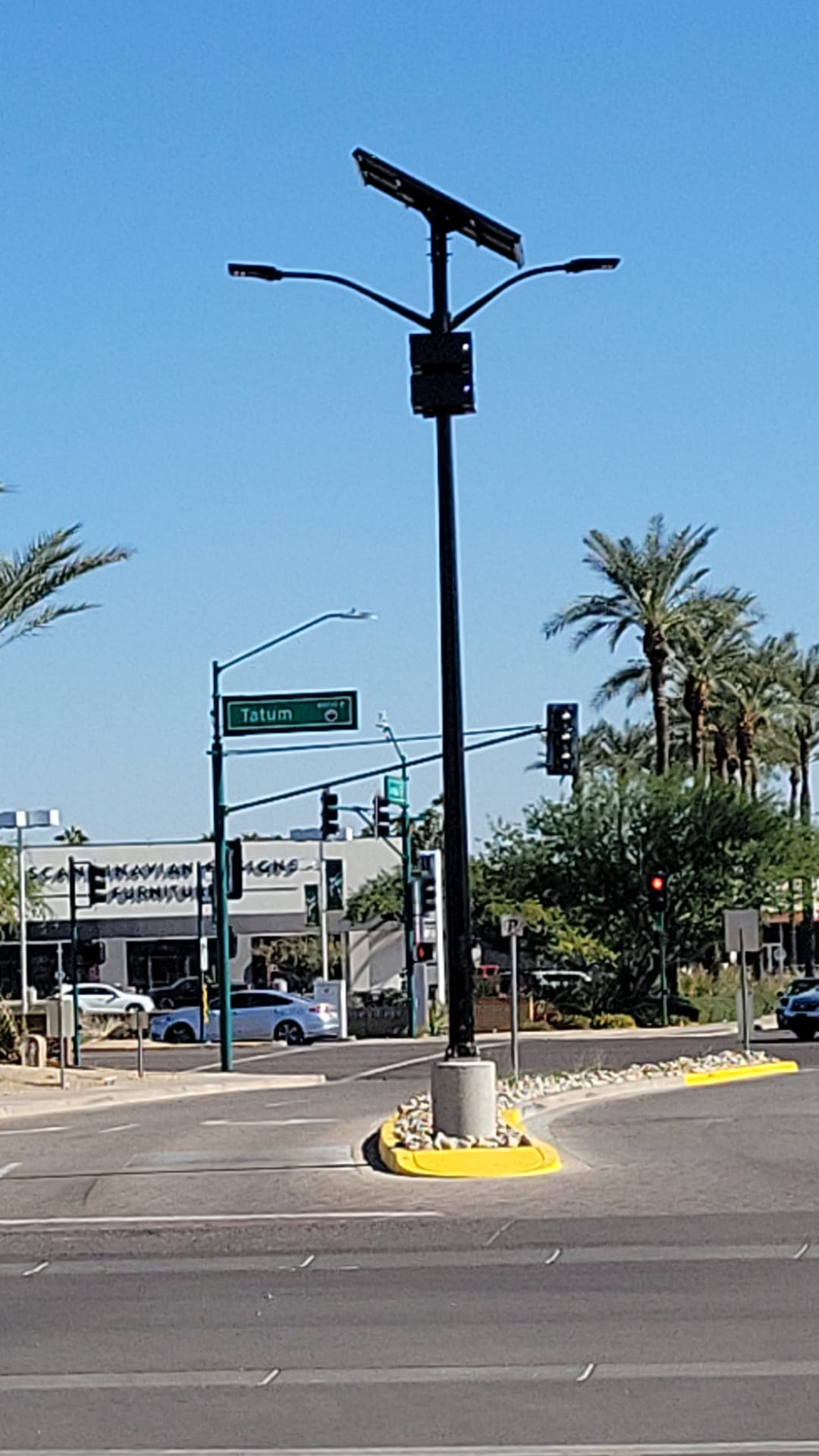
SolarPath all-in-two fixtures are the specification for reservation roads and community corridors. Mounted at 25 to 30 foot pole heights, they deliver 6,000 to 12,000 lumens per fixture with Type III distribution and 2 to 3 footcandles average maintained.
All-in-one fixtures suit community centers, housing areas, and school zones at 15 to 25 foot pole heights with 3,000 to 6,000 lumen output. Solar bollards light walking paths and gathering areas with grid-independent, low-glare illumination.
Explore our full product catalog to match fixtures to your community’s roads, facilities, and gathering places.
Field example – community road lighting. A tribal community needed to light a road segment serving housing and a community center, miles from the nearest utility service point. SolarPath delivered pole-mounted off-grid fixtures at full IES RP-8 levels, installed in days with no grid extension, no trenching, and no recurring energy cost — infrastructure the community owns outright.
Every SolarPath tribal project is photometrically engineered to the site. Our team delivers a stamped IES RP-8 compliant photometric study, an autonomy calculation tied to site peak sun hours, and a commissioning checklist completed on handover — documentation that supports TTP, BIA, and ICDBG funding applications. We contract directly with tribal governments and housing authorities, respecting tribal sovereignty and procurement processes.
Every project ships with a stamped photometric study confirming lux targets, uniformity ratios, and fixture placement before procurement.
3000K and 4000K CCT with full-cutoff optics meet International Dark-Sky Association ordinances and county regulations.
Standard coverage on the photovoltaic panel, LiFePO4 battery, MPPT charge controller, and LED array across every SolarPath fixture.
Off-grid lighting is community-owned infrastructure. No grid extension means remote roads and facilities get lit without waiting on utility line construction. No utility billing means no monthly energy cost and no exposure to rate increases. Low maintenance means service visits on a multi-year cadence, with training available for tribal maintenance crews. UL and Dark Sky listings meet federal funding specification requirements, and quick installation finishes a 10-fixture project in under one week including photometric commissioning and handover documentation.
lower installed cost than comparable grid-tied lighting projects, driven by avoided trenching and electrical work.
typical ROI payback on solar lighting retrofits where trenching costs are avoided (industry average).
in trenching and electrical costs avoided on a typical 20-fixture retrofit.
Specification | Value |
Target Footcandles | 1 to 3 fc average maintained |
Uniformity Ratio | Below 4:1 (IES RP-8 roadway) |
Pole Height | 20 to 30 ft |
Pole Spacing | 60 to 100 ft |
Recommended Fixture | All-In-Two Solar Street Light |
Typical Wattage | 60 to 100 W per fixture |
Typical Lumen Output | 6,000 to 10,000 lm |
Autonomy Days | 4 nights standard |
Install Time | 5 to 10 crew days for 20 fixtures |
Warranty | Product-specific |
The Tribal Transportation Program (TTP), the BIA Road Maintenance Program, Indian Community Development Block Grants (ICDBG), and tribal housing authority capital budgets all fund community lighting projects. SolarPath provides the photometric studies, specifications, and cost documentation that funding applications require.
IES RP-8 and RP-20 specify 1 to 3 footcandles average maintained with uniformity ratios below 4:1. Roads and intersections target the higher end; walking paths and gathering areas target the lower end. SolarPath photometric studies confirm targets per site.
No. Every SolarPath fixture is fully self-contained: solar panel, LiFePO4 battery, and MPPT controller on the pole. There is no grid extension, no trenching, no utility coordination, and no monthly bill — which is what makes remote community projects viable.
5 to 10 crew days for a 20-fixture project including foundation pour, pole erection, fixture mounting, and photometric commissioning. No trenching and no utility interconnection keeps the work fast and non-disruptive.
Yes. Every SolarPath fixture ships UL and Dark Sky listed, meeting federal funding specification requirements, and full-cutoff 3000K optics preserve dark skies over the community.
Four nights standard. Remote and northern sites specify five to seven-night autonomy to cover extended overcast conditions. Autonomy is calculated against site peak sun hours in every SolarPath photometric package.
Yes. SolarPath contracts directly with tribal governments, tribal housing authorities, and tribal enterprises, follows tribal procurement processes, and offers maintenance training for tribal crews so the community operates its own lighting infrastructure.
Request a stamped IES RP-8 photometric study and a fixture-count estimate for your site. No utility coordination, no electrical permit, no recurring energy cost.
Or call 201-490-4499