
Federal and military lighting projects carry procurement gates most manufacturers cannot clear: Build America, Buy America (BABA) domestic content requirements, Buy American Act posture on direct federal purchases, Davis-Bacon labor standards on funded construction, and IES RP-8 illumination criteria with uniformity ratios below 4:1 and 1 to 3 footcandles average maintained. Traditional grid-tied lighting adds another layer — trenching through secured areas, utility coordination, and electrical permits that slow projects for months.
SolarPath Sun Solutions clears both. Our fixtures are engineered for BABA-compliant procurement, and every system is fully off-grid: a lithium iron phosphate (LiFePO4) battery, MPPT charge controller, and photovoltaic panel on the pole. A 20-fixture perimeter or roadway segment installs in 5 to 10 crew days with no trenching through secured areas, no utility coordination, and no recurring energy cost — at 40 to 60 percent of the installed cost of a grid-tied equivalent. IP66 ingress protection and a -40 F to 158 F operating range cover every US installation climate.
Typical deployments: base perimeter and fence-line lighting, motor pools and equipment yards, housing areas, gate and access-control points, and recreation facilities. Browse our all-in-two street lights, all-in-one fixtures, and canopy lights.
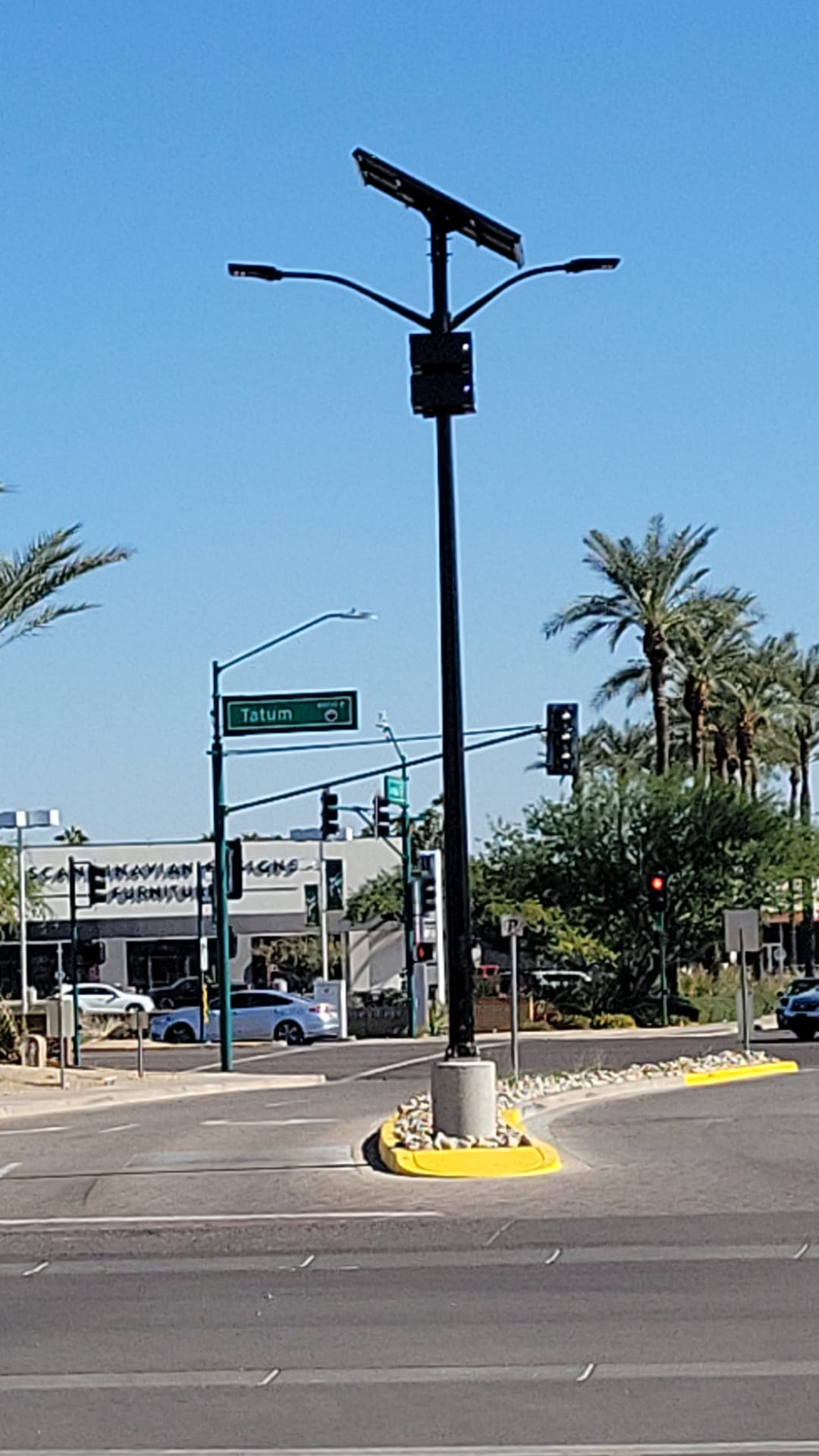
SolarPath all-in-two fixtures are the specification for perimeter roads, motor pools, and base roadways. Mounted at 25 to 30 foot pole heights, they deliver 6,000 to 12,000 lumens per fixture with Type III distribution and 2 to 3 footcandles average maintained.
All-in-one fixtures suit gate areas, housing streets, and walkways at 15 to 25 foot pole heights with 3,000 to 6,000 lumen output. Solar canopy lights cover guard shelters, covered inspection lanes, and walkway canopies with low-profile under-canopy mounting.
Explore our full product catalog to match fixtures to your site plan and target lux.
Field example – installation access road. A federal facility needed continuous lighting on an access road segment with no existing conduit and a security requirement to avoid open trenches. SolarPath delivered pole-mounted off-grid fixtures at full IES RP-8 levels, installed in days with no trenching, no utility coordination, and no recurring energy cost.
Every SolarPath federal project is photometrically engineered to the site. Our team delivers a stamped IES RP-8 compliant photometric study, an autonomy calculation tied to site peak sun hours, and a commissioning checklist our field team completes on handover. Dark-sky and airfield-adjacent optics packages are available where light-spill control is mission-critical.
Every project ships with a stamped photometric study confirming lux targets, uniformity ratios, and fixture placement before procurement.
3000K and 4000K CCT with full-cutoff optics meet International Dark-Sky Association ordinances and county regulations.
Standard coverage on the photovoltaic panel, LiFePO4 battery, MPPT charge controller, and LED array across every SolarPath fixture.
Off-grid lighting reshapes federal project delivery. No trenching means no digging permits inside secured perimeters and no disturbance of unknown underground infrastructure. No utility connection means lighting that stays on when the grid fails — energy resilience by default, with up to 7 days of battery autonomy. No metering means no recurring energy cost against the operations budget. UL and Dark Sky listings meet federal specification requirements, and quick installation finishes a 10-fixture segment in under one week including photometric commissioning and handover documentation.
lower installed cost than comparable grid-tied lighting projects, driven by avoided trenching and electrical work.
typical ROI payback on solar lighting retrofits where trenching costs are avoided (industry average).
in trenching and electrical costs avoided on a typical 20-fixture retrofit.
Specification | Value |
Target Footcandles | 1 to 3 fc average maintained |
Uniformity Ratio | Below 4:1 (IES RP-8 parking) |
Pole Height | 20 to 30 ft |
Pole Spacing | 60 to 100 ft |
Recommended Fixture | All-In-Two Solar Street Light |
Typical Wattage | 60 to 100 W per fixture |
Typical Lumen Output | 6,000 to 10,000 lm |
Autonomy Days | 4 nights standard |
Install Time | 5 to 10 crew days for 20 fixtures |
Warranty | Product-specific |
SolarPath designs, engineers, assembles, and supports solar lighting solutions for municipal, commercial, and infrastructure applications.
For projects subject to Build America, Buy America (BABA) requirements, SolarPath can provide supporting documentation, including manufacturer affidavits, bills of materials (BOMs), mill certificates, and other project-specific documentation required for compliance review.
BABA eligibility is determined based on the specific product configuration and project requirements. Documentation is provided by SolarPath to support the customer’s compliance review and procurement process.
Because BABA requirements may vary by project, funding source, and applicable regulations, compliance is evaluated on a project-by-project basis.
SolarPath works closely with project teams, engineers, contractors, and public agencies to support BABA documentation requirements when applicable.
Yes. SolarPath maintains a Build America, Buy America compliance program with domestic manufacturing and content documentation, including bill-of-materials and mill certification support. See our BABA compliance statement for details, and contact us for project-specific certification letters.
IES RP-8 and RP-20 criteria specify 1 to 3 footcandles average maintained with uniformity ratios below 4:1 for roadways and general site areas. Perimeter, gate, and security lighting requirements are confirmed per site against the applicable facility criteria. SolarPath photometric studies document compliance point by point.
5 to 10 crew days for a 20-fixture segment including foundation pour, pole erection, fixture mounting, and photometric commissioning. Because there is no trenching and no utility interconnection, work stays above grade and inside a compact footprint — a significant advantage where digging permits and escorts slow conventional electrical work.
At 25 to 30 foot pole heights, fixtures space at 60 to 100 feet depending on target light levels and distribution type. A photometric study calculates the exact count and placement for your perimeter length, gate layout, or roadway segment.
Yes. Every SolarPath fixture ships UL and Dark Sky listed, meeting federal specification and procurement requirements nationwide.
Four nights standard. Mission-critical and northern sites specify five to seven-night autonomy to cover extended overcast conditions. Autonomy is calculated against site peak sun hours in every SolarPath photometric package.
Yes. Full-cutoff optics with 3000K CCT, shielding options, programmable dimming, and scheduled shutoffs control light spill for airfield-adjacent and observatory-adjacent installations, and meet IDA dark-sky ordinance requirements.
Request a stamped IES RP-8 photometric study and a fixture-count estimate for your site. No utility coordination, no electrical permit, no recurring energy cost.
Or call 201-490-4499