
federally funded projects require consistent illumination meeting IES RP-8 standards, with uniformity ratios below 4:1 and minimum maintained footcandles between 1 and 3 across the site. Traditional grid-tied infrastructure lighting forces trenching through asphalt, utility service drops, electrical permits, and decades of monthly energy billing. A typical 20-fixture retrofit runs 6 to 12 weeks and $80,000 to $150,000 in trenching and electrical work before a single fixture mounts.
SolarPath Sun Solutions eliminates every trenching step. Each fixture runs on a lithium iron phosphate (LiFePO4) battery, MPPT charge controller, and high-efficiency photovoltaic (PV) panel mounted on the pole. A 20-fixture infrastructure installs in 5 to 10 crew days at 40 to 60 percent of the total installed cost of a grid-tied equivalent. IP66 ingress protection, -40 F to 158 F operating range, and UL listing make SolarPath fixtures rebate-eligible and procurement-ready for retail, healthcare, institutional, and municipal parking projects.
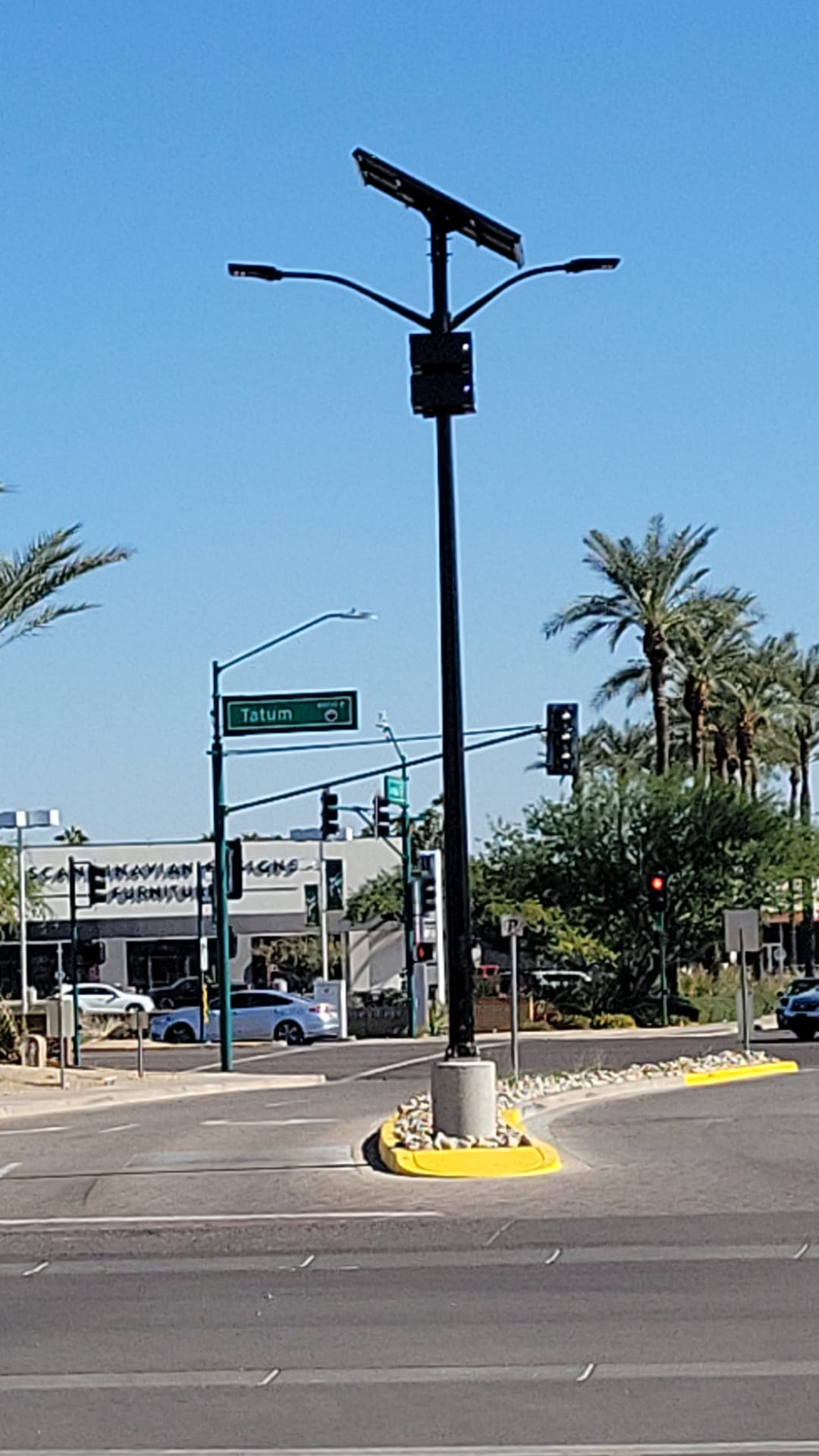
Browse our all-in-two street lights, all-in-one fixtures, and canopy lights for infrastructure deployments.
SolarPath provides solar lighting solutions compliant with Build America, Buy America (BABA) and Buy America Act (BAA) requirements for qualifying projects. Because BABA/BAA compliance depends on each project’s specific requirements and configuration, eligibility is determined at the project level rather than offered as a fixed product list.
For projects that require it, SolarPath supplies full documentation packages upon request — including domestic content verification, supplier certifications, and compliance statements. BABA documentation is provided only for projects where it is required.
Contact our team to confirm BABA-compliant configurations for your project and request the supporting documentation.
Field example – federally funded project. An agency pursuing federal infrastructure dollars required Build America, Buy America documentation. SolarPath supplied procurement-ready off-grid fixtures with the listings and paperwork the funding program required, keeping the lighting scope eligible and the timeline on track. Confirm specific product BABA status with our team.
Every SolarPath infrastructure project is photometrically engineered to the site. Our team delivers a stamped IES RP-8 compliant photometric study, an autonomy calculation tied to site peak sun hours, and a commissioning checklist our field team completes on handover.
Every project ships with a stamped photometric study confirming lux targets, uniformity ratios, and fixture placement before procurement.
3000K and 4000K CCT with full-cutoff optics meet International Dark-Sky Association ordinances and county regulations.
Standard coverage on the photovoltaic panel, LiFePO4 battery, MPPT charge controller, and LED array across every SolarPath fixture.
Off-grid infrastructure lighting reshapes project economics. Eliminating trenching means construction proceeds without waiting for underground utility coordination. Eliminating utility billing means no monthly energy cost, no demand charges, and no exposure to rate increases over the fixture lifetime. Low maintenance requirements mean service visits occur on a multi-year cadence rather than monthly or quarterly. UL and Dark Sky listings open federal, state, municipal, and corporate procurement contracts with rebate eligibility in most states. Quick installation finishes a 10-fixture infrastructure in under one week including photometric commissioning and handover documentation.
lower installed cost than comparable grid-tied lighting projects, driven by avoided trenching and electrical work.
typical ROI payback on solar lighting retrofits where trenching costs are avoided (industry average).
in trenching and electrical costs avoided on a typical 20-fixture retrofit.
Specification | Value |
Target Footcandles | 1 to 3 fc average maintained |
Uniformity Ratio | Below 4:1 (IES RP-8 parking) |
Pole Height | 20 to 30 ft |
Pole Spacing | 60 to 100 ft |
Recommended Fixture | All-In-Two Solar Street Light |
Typical Wattage | 60 to 100 W per fixture |
Typical Lumen Output | 6,000 to 10,000 lm |
Autonomy Days | 4 nights standard |
Install Time | 5 to 10 crew days for 20 fixtures |
Warranty | Product-specific |
SolarPath designs, engineers, assembles, and supports solar lighting solutions for municipal, commercial, and infrastructure applications.
For projects subject to Build America, Buy America (BABA) requirements, SolarPath can provide supporting documentation, including manufacturer affidavits, bills of materials (BOMs), mill certificates, and other project-specific documentation required for compliance review.
BABA eligibility is determined based on the specific product configuration and project requirements. Documentation is provided by SolarPath to support the customer’s compliance review and procurement process.
Because BABA requirements may vary by project, funding source, and applicable regulations, compliance is evaluated on a project-by-project basis.
SolarPath works closely with project teams, engineers, contractors, and public agencies to support BABA documentation requirements when applicable.
IES RP-20 and RP-8 specify 1 to 3 footcandles average maintained with uniformity ratios below 4:1. Retail and institutional lots target the higher end. Employee and long-stay lots target the lower end. SolarPath photometric studies confirm targets per site.
20 to 30 feet is the standard range. Small lots and low-speed areas use 20 feet. Standard lots use 25 feet. Large lots and higher-mounting-height codes use 30 feet. Pole height depends on target lux, fixture distribution type, and spacing.
5 to 10 crew days for a 20-fixture lot including foundation pour, pole erection, fixture mounting, and photometric commissioning. No trenching, no utility coordination, no electrical permits in most jurisdictions.
A typical 100-space retail infrastructure uses 8 to 12 fixtures at 25-foot pole heights. A 200-space lot uses 15 to 20 fixtures. SolarPath photometric studies calculate the exact fixture count and placement based on your site dimensions and target lux.
Yes. Every SolarPath infrastructure fixture ships UL and Dark Sky listed, unlocking utility rebate eligibility and meeting federal, state, and municipal procurement specifications nationwide.
Four nights standard. Sites in the Sun Belt may ship with three-night autonomy. Northern and Pacific Northwest sites ship with five to seven-night autonomy to cover extended overcast winter conditions.
Yes. Programmable dimming, PIR motion sensors, and scheduled shutoffs meet California Title 24 Part 6 outdoor lighting controls. 3000K CCT with full-cutoff optics meets IDA dark-sky ordinances in Arizona, Colorado, Florida, and other jurisdictions.
Request a stamped IES RP-8 photometric study and a fixture-count estimate for your site. No utility coordination, no electrical permit, no recurring energy cost.
Or call 201-490-4499