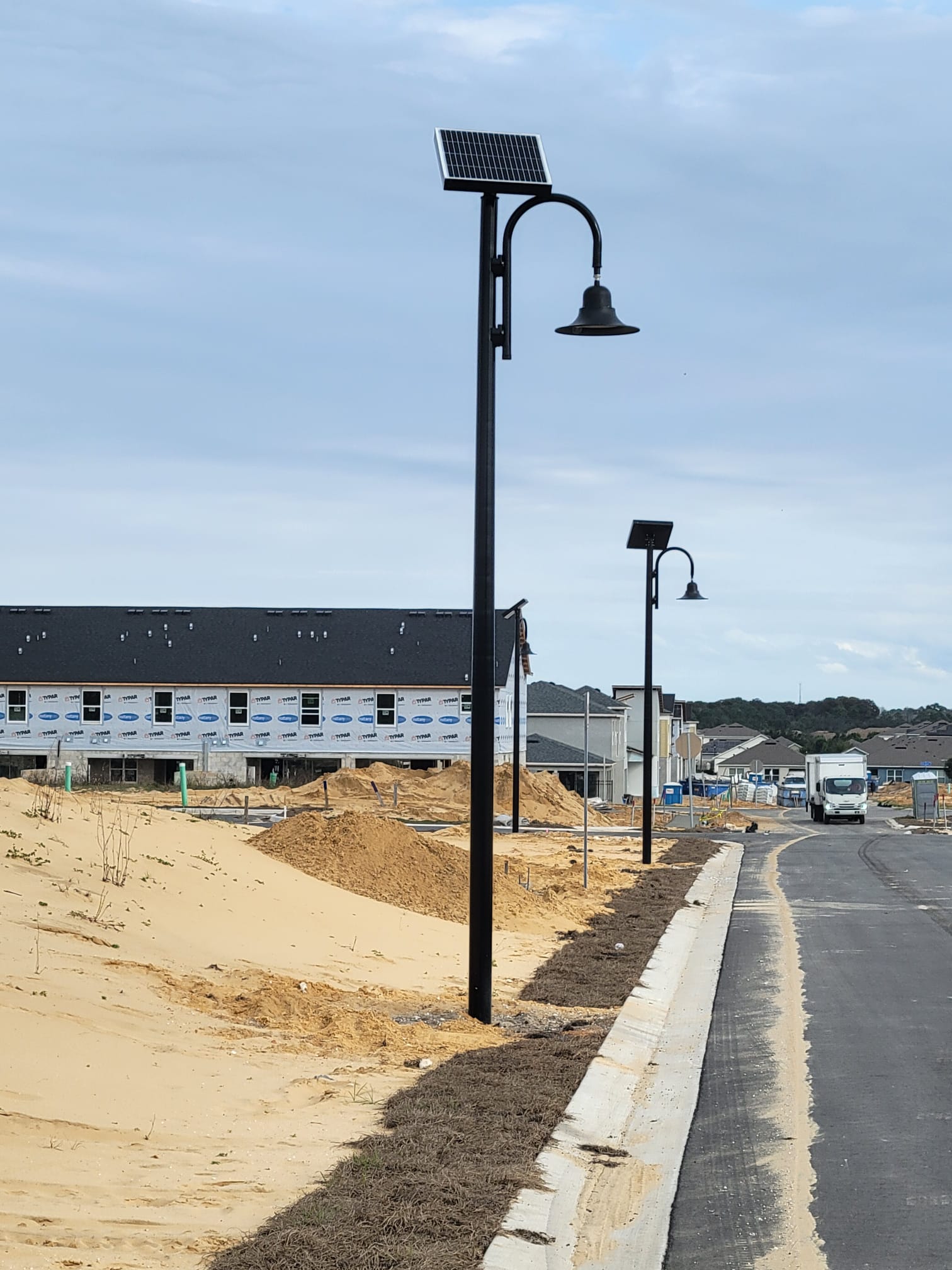
The core difference between off-grid vs. hybrid solar lighting is the power connection. Off-grid fixtures run entirely on a solar panel and a battery, with no utility wiring at all. Hybrid fixtures pair solar and a battery with a grid connection that takes over when stored energy runs low. Your site, budget, and outage tolerance decide which one fits.
Picking the wrong one gets expensive either way. Choose off-grid for a shady site with an undersized battery, and the lights dim by the third cloudy night. Choose hybrid for a remote lot, and you pay to trench power to a place that never needed it.
This guide compares both systems on cost, reliability, installation, and upkeep. You’ll see where each one wins, where each one struggles, and a simple process for deciding. It’s written for facility managers, municipal planners, developers, and property owners who need lights that work every night, not just the sunny ones.
What Is Off-Grid Solar Lighting?
Off-grid solar lighting is a self-contained fixture that makes, stores, and uses its own power. A photovoltaic (PV) panel charges a battery during the day, a charge controller manages that energy, and an LED head runs off the battery at night. There’s no utility connection, no trenching, and no electric bill.
Each part has a job. The panel size sets how much energy you collect on a short winter day. The battery sets autonomy, meaning how many nights the light can run without fresh sun. An MPPT (maximum power point tracking) charge controller pulls more charge from the panel than an older PWM controller, which matters most in weak light.
Battery chemistry is where cheap fixtures cut corners. SolarPath Sun Solutions builds its fixtures around lithium iron phosphate (LiFePO4) batteries rated for 3,850+ deep cycles while still holding 80 percent capacity. Sealed lead-acid batteries wear out much sooner under nightly cycling. Our solar light battery comparison breaks down the options.
Off-grid fixtures come in two layouts. All-in-one units put the panel, battery, controller, and LED in a single housing. All-in-two units separate the panel from the light head so it can tilt toward the sun on its own, which helps on tall poles. Here’s how all-in-one and all-in-two lights compare.
What Is Hybrid Solar Lighting?
Hybrid solar lighting combines a solar panel and battery with a backup power source, usually the utility grid. The fixture runs on solar first. When the battery drops below a set level, often after several dark days, it draws grid power so the light never goes out.
The appeal is the safety net. Designers can size the panel and battery smaller, since the grid covers the worst weeks of winter. That makes hybrid fixtures attractive in cloudy climates and on high-wattage roadway poles where a fully solar design would need a very large panel.
The catch is simple. Hybrid lighting is still wired. Every pole needs a conduit run, a utility service connection, an electrical permit, and a monthly bill, even if that bill is small. You keep much of the installation cost and schedule of a conventional grid-tied light.
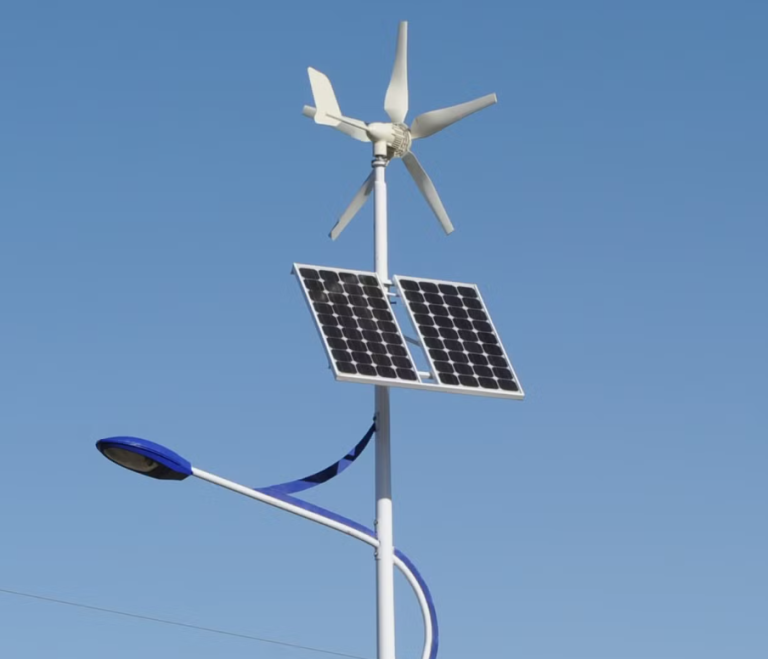
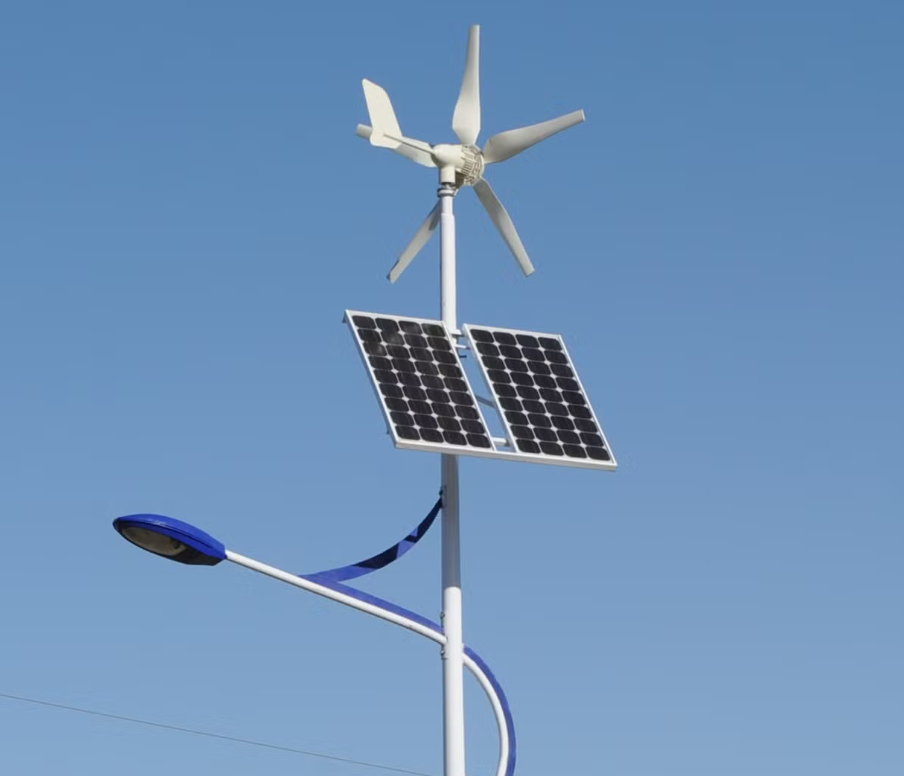
You’ll also see the word hybrid used for solar-wind fixtures, which add a small turbine to the pole. Those are a separate category with moving parts to maintain. In this guide, hybrid means solar plus grid backup, which is the usual meaning on commercial and municipal projects.
Off-Grid vs Hybrid Solar Lighting: Key Differences
Off-grid lighting wins on install speed, independence, and zero energy cost. Hybrid lighting wins on guaranteed fallback power in poor-sun locations. Most of the other differences come back to one question: is power already close by, or would you have to bring it in?
| Factor | Off-grid solar lighting | Hybrid solar lighting |
|---|---|---|
| Power source | Solar panel and battery only | Solar and battery, with grid backup |
| Utility connection | None | Required at every pole |
| Trenching and conduit | None | Usually required |
| Monthly energy bill | None | Small, but ongoing |
| Panel and battery size | Sized for the worst month | Can be smaller |
| Runs during a grid outage | Yes, as designed | Yes, until the battery drains |
| Copper theft exposure | No buried wire | Buried wire and pull boxes |
| Install timeline | Days | Weeks to months, tied to utility work |
| Best fit | Remote, new, or hard-to-wire sites | Sites with live circuits already in place |
Notice that both systems keep lighting through a short outage, as long as the battery holds charge. The gap shows up over a long gray stretch. Off-grid relies on the autonomy you designed in, while hybrid leans on a grid that only helps if it’s up.
How Each System Performs at Night and in Bad Weather
Reliability comes down to two situations: weeks without much sun, and days without grid power.
Cloudy Weeks & Short Winter Days
An off-grid light’s winter performance depends on autonomy and peak sun hours (PSH). Autonomy is the number of nights a fully charged battery can run the light with no recharge. A well-engineered system plans for the shortest days of December, not the average sun of June.
Many projects specify several nights of autonomy, and some all-in-one fixtures are rated for up to seven. Smart dimming stretches that further. A common profile runs full output for the first hours after dusk, then drops to a lower level once traffic falls off, with motion sensors bringing it back up when someone approaches.
Hybrid fixtures handle a gray week differently. The battery drains, the controller switches to grid power, and the light stays at full brightness. That’s the main reason designers pick hybrid for high-wattage roads in places with long, overcast winters.
The classic mistake is sizing an off-grid light on annual average sun. A system that looks fine on paper in July can come up short in the second week of a December storm. Ask any supplier which month their autonomy calculation is based on. If the answer isn’t the worst month for your site, the design is too optimistic.
Grid Outages and Storm Resilience
During a grid outage, an off-grid light behaves exactly as it did the night before, because it never relied on the grid. A hybrid light keeps running on its battery. Once that battery drains, though, it has nothing to fall back on until utility power returns.
That difference matters most after hurricanes, ice storms, and wildfire shutoffs, when outages can last days. Evacuation routes, shelters, bus stops, and crosswalks are exactly the places that need light while the grid is down.
Storm-prone coastal and island sites show this clearly. For off-grid solar lighting in Puerto Rico, a self-contained pole with no buried wiring keeps working through a storm-season outage without waiting on a utility repair crew. Wind rating still matters, so confirm the pole and panel mount are engineered for local wind-load requirements.
Off-grid poles also remove a quieter risk. With no underground copper to pull, there’s nothing for thieves to strip out of pull boxes and nothing for a backhoe to cut. Hybrid systems keep that exposure, since every pole still sits on a buried circuit.
Cost Comparison: Installation, Energy, & Maintenance
Off-grid solar lighting often costs more per fixture but less per project, because it skips the trenching and electrical work. Hybrid fixtures can use a smaller panel and battery, but they bring back most of the wiring cost of a grid-tied light. On sites with no existing power, that wiring is often the biggest line item.
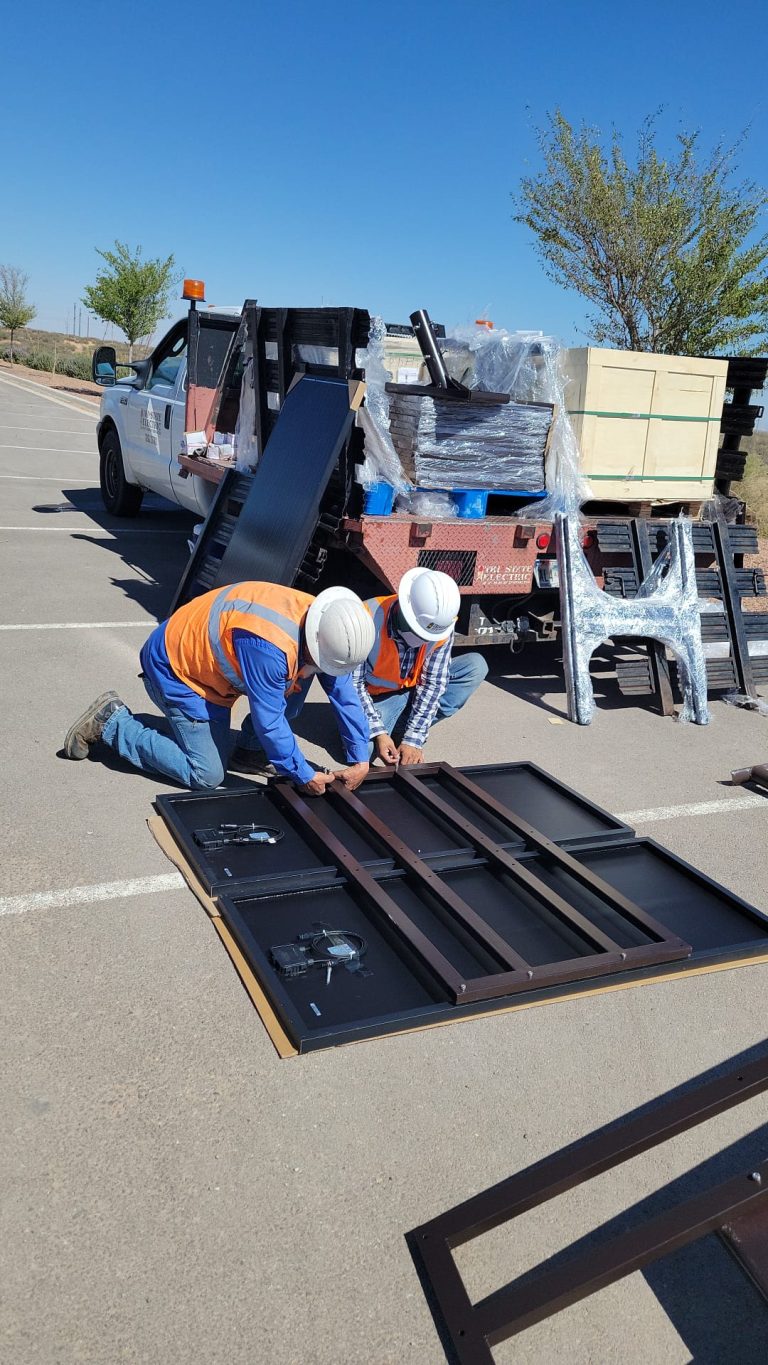
Our own project figures show the scale. A typical 20-fixture grid-tied retrofit can take 6 to 12 weeks and $80,000 to $150,000 in trenching and electrical work before a single fixture mounts. A comparable off-grid site installs in 5 to 10 crew days at roughly 40 to 60 percent of the total installed cost (estimates as of October 2026).
| Cost item | Off-grid solar lighting | Hybrid solar lighting |
|---|---|---|
| Fixture hardware | Higher, larger panel and battery | Lower, smaller panel and battery |
| Trenching, conduit, and wire | None | Similar to a grid-tied light |
| Utility service drop and permits | None | Required |
| Monthly energy cost | Zero | Low, but never zero |
| Battery replacement | Main long-term cost | Also needed, often smaller pack |
| Damage and theft repairs | Fixture-level only | Fixture plus buried circuit |
Over the life of the system, the battery is the main maintenance item for both types. Hybrid owners also carry the utility bill, any circuit repairs, and the cost of locating and fixing faults underground. Payback depends on local power rates and how much trenching you avoid, and our solar lighting ROI guide walks through that math.
When Off-Grid Solar Lighting Is the Better Fit
Off-grid lighting fits any site where bringing in power would cost more than the lights themselves. That covers new parking lots far from a transformer, rural roads, trails, and temporary sites. It also fits projects where outage resilience or a tight deadline matters.
Off-grid is usually the right call for:
- Remote sites with no utility service within reach
- Parks, trails, and greenways where trenching would tear up landscaping
- New parking lots and developments before permanent power is built out
- Bus stops, transit shelters, and crosswalks that must stay lit during outages
- Construction zones and other temporary sites
- Grant-funded projects with hard completion deadlines
- Sites with a history of copper wire theft
Cold climates are workable with the right battery. LiFePO4 is rated to operate from -40 F to 158 F and to keep over 80 percent capacity at 14 F, so solar street lights for sites in Alaska get designed around short days and deep cold rather than ruled out by them. The answer is usually a larger panel tilted for low winter sun, plus extra autonomy.
When a Hybrid System Makes More Sense
A hybrid system makes sense when power is already at the pole, and the grid is dependable. If you’re upgrading existing streetlights with live circuits, adding solar can cut energy use without throwing away wiring you already paid for.
It also suits very high-output loads in places with long overcast seasons. A fully solar design for a major arterial road can need a large panel and battery to cover the darkest weeks. Letting the grid handle those weeks keeps the fixture smaller and lighter on the pole.
Some owners simply want a guaranteed fallback written into the spec, and hybrid gives them that. It’s a reasonable choice when the cost of a dark night is high, and the circuit is already there.
Be honest about what hybrid saves, though. If the conduit, wire, and service connection already exist, hybrid is a smart upgrade. If you’d have to build all of that new, you’re paying close to full grid-tied installation cost for a light that still runs mostly on solar. In that case, a properly sized off-grid design usually costs less and installs faster.
How to Choose the Right System for Your Site
Most off-grid vs hybrid solar lighting decisions start with power access, then move through sun, lighting targets, uptime, and full installed cost. A site visit and a utility map answer the first two questions on most projects.
- Check for existing power. If live circuits already reach your pole locations, hybrid is on the table. If not, price the trenching before anything else.
- Find your worst-month sun hours. Size around December, or whichever month has the fewest peak sun hours at your site.
- Set your lighting target. Parking lots and roadways follow IES RP-20 and RP-8 guidance for footcandles and uniformity. Know your numbers before comparing fixtures.
- Define your uptime needs. Decide how many cloudy nights the lights must cover, and whether full brightness all night is required or dimming is acceptable.
- Compare full installed cost. Add trenching, permits, utility fees, and energy bills to the fixture price. Fixture price alone is misleading.
- Ask for a photometric study. It confirms pole heights, spacing, and fixture counts before you buy anything.
SolarPath Sun Solutions includes a stamped photometric study with every project, which is the step that catches an undersized design early. We engineer off-grid solar street lights and site lighting for projects in all 50 states, matching panel, battery, and autonomy to each site’s sun data. For parking lots specifically, our guide on sizing a solar street light system walks through the numbers.
Common Mistakes That Undercut Either System
The most common mistake is buying on fixture price alone. A low-cost light with a small battery and a lead-acid pack can look like a bargain, then fail in its first hard winter. Total installed cost and real autonomy tell you far more than the sticker.
Shading catches a lot of people too. A tree that’s a sapling today can shade a panel in five years, and a new building next door can do it overnight. Check the sun path for every pole, not just the site as a whole.
Dark-sky rules get missed as well. Many towns and counties limit glare and uplight, so look for full-cutoff optics and warmer color temperatures such as 3000K or 4000K where local ordinances apply.
Don’t assume hybrid means outage-proof. It only covers you until the battery runs down. And don’t skip maintenance on either type: panels in dusty, snowy, or coastal areas need occasional cleaning, and a quick yearly check of battery health and controller settings keeps small issues from turning into dark poles.
Frequently Asked Questions
Do hybrid solar lights work during a power outage?
Yes, for a while. A hybrid light runs on its battery when the grid goes down, just like an off-grid light. The difference is what happens next. Once the battery drains, a hybrid light has no other source until utility power returns, while an off-grid light keeps recharging from the sun each day.
Do off-grid solar lights work in winter?
They do when they’re sized for winter. The design should be based on the site’s worst month for sun, with enough battery autonomy to cover several cloudy nights in a row. LiFePO4 batteries handle cold far better than lead-acid, and dimming schedules help stretch stored energy through long nights.
Is off-grid or hybrid solar lighting cheaper?
On sites without existing power, off-grid is usually cheaper overall because it skips trenching, conduit, permits, and utility connections. The fixture itself may cost more. On sites where live circuits already reach every pole, hybrid can come out ahead because the expensive wiring work is already done.
How long do solar light batteries last?
It depends on chemistry and how deeply the battery cycles each night. LiFePO4 batteries rated for thousands of deep cycles typically last many years in nightly use, while sealed lead-acid packs wear out much sooner. Battery replacement is the main long-term maintenance cost for both off-grid and hybrid systems.
Can an off-grid solar light be converted to hybrid later?
Sometimes, but it’s rarely worth it. Adding grid backup means running conduit and wire to the pole, getting a permit, and setting up a service connection, which is most of the cost you avoided by going off-grid. Sizing the off-grid system correctly from the start is usually the better fix.
Is a hybrid solar light the same as a solar-wind light?
Not quite. In commercial and municipal lighting, hybrid most often means solar with grid backup. Solar-wind lights add a small turbine to the pole to generate extra power in windy, low-sun locations. They avoid grid wiring, but the turbine adds moving parts that need regular maintenance.
Get a Lighting Plan Built Around Your Site
If your site has no convenient power, or trenching would eat your budget, off-grid solar lighting is usually the faster and cheaper path. Hybrid earns its place where live circuits already run to the pole. Either way, the right answer comes from your sun hours, lighting targets, and uptime needs, not a catalog photo.
SolarPath Sun Solutions designs off-grid solar street lights and site lighting for projects across all 50 states and Puerto Rico, with a stamped photometric study on every project. Call us at 201-490-4499 or email [email protected], and our team will respond within one business day.
Send us your site layout, fixture count, and timeline, and we’ll recommend the right fixture and autonomy for it.
Prices and timelines are estimates and may vary by site. Contact us for a current quote.